
China's deteriorating economy is a serious concern. Xi Jinping and China's new premier will have a difficult task ahead of them after the 20th party congress, notes Jayadeva Ranade, the retired senior RA&W officer and China expert.

If China's behaviour in the past on ticklish issues is any indication then China could eventually support India's NSG application, says Rup Narayan Das.
Xi's visit to Nyingchi, bordering Arunachal Pradesh, signals China's opening of another front to India in the eastern sector, observes Srikanth Kondapalli, the leading China expert.
'India finds itself in an unenviable situation today with its prospects diminished by acutely polarised domestic politics and the setbacks suffered during the pandemic,' notes Ambassador Shyam Saran, the former foreign secretary.

Chinese President Xi Jinping arrived in Ahmedabad on Wednesday on a three-day visit, which is expected to define the relationship between the two neighbours who have had a troubled past.

The Chinese Communist party's central committee on Thursday, November 11, adopted a landmark resolution on the party's 'major achievements and historic experiences', effectively consolidating CCP General Secretary Xi Jinping's lifelong hold on power.

Bangladesh is in turmoil, which is not good news for India, which shares a porous 4000 km border with it. There is a danger of fundamentalism growing there, and India has to move in to reset its ties with the new dispensation before China and Pakistan make capital out of it, alerts Ramesh Menon.
Xi's concept of "socialism with Chinese characteristics for a new era" was added to the party's Constitution

Chinese President Xi Jinping has asked the People's Liberation Army to be combat ready to win a "regional war" and make sure that all decisions from the central leadership are strictly followed.

After the outbreak of the pandemic in the country he has ruled with an iron hand in recent years, Xi Jinping, general secretary of the Communist party of China, has mostly stayed put in Beijing.

Take a look back at the two politicos over the years.

India needs to be alert on how the Doklam standoff plays into the factional infighting in China's Communist Party, says Ambassador Shyam Saran, the former foreign secretary.

'The title of 'core' of the leadership gives Xi Jinping greater political authority at a time when China is beset by various problems as well as a slowdown in economic growth,' points out former RA&W officer Jayadeva Ranade.

Chinese foreign policy will acquire a more ideological and less pragmatic character. It will be conducted with more nationalist overtones, predicts former foreign secretary Shyam Saran.

India has got cracking into setting up its eyes and ears in the Indian Ocean

For a rising country like China with its sights set on global and regional power, any coming together of the US and India is the worst case scenario. Hence, China is concerned with the emerging equations between New Delhi and Washington, says Srikanth Kondapalli.

To rise quickly in the PLA's hierarchy, you need to be close to Xi Jinping. Retired RA&W officer Jayadeva Ranade on the changes in China's military leadership.

Zhu, 56, was found to have hanged himself in the office's garage, a report on the online edition of Chinese magazine Caixin said.
President Xi Jinping was on Thursday elevated as the "core leader" of China's ruling Communist Party, conferring on him a status similar to that of party founder 'Chairman' Mao Zedong that dilutes the three-decade-old collective leadership principle to avoid personality cult.
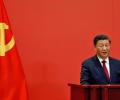
Xi's ascent to power and the quick consolidation of his leadership of the party with a shock anti-graft campaign securing the title of the "core leader" of the party bequeathed only to Mao has indeed forced his rivals in the party to submission and caught the attention of the world.

The Politburo Standing Committee -- the most powerful body in China -- is unveiled, but in a break from Communist party convention, no successor to Xi Jinping is named.

'In the short term the relationship will get worse.'

Taiwan considers itself a sovereign state -- but China views the self-ruled island as a breakaway province. Beijing has not ruled out the possible use of force to achieve unification.
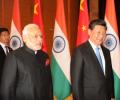
While the two sides' objectives may appear to differ, it is clear that both India and China are emphasising on the common minimum possible areas of cooperation between them, says Srikanth Kondapalli.
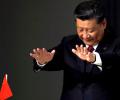
The Chinese leader is today facing some open, or less subtle, criticism from within the party and from liberal intellectuals who are increasingly concerned by the concentration of power in his hands and the increasing authoritarianism of the regime, says Claude Smadja.
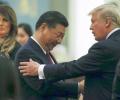
'While many Chinese policy makers dismiss the political, economic and technological component of US-India relations, they express caution on the defence-related ties which also happens to be a major driver in US-India relations,' explains China expert Srikanth Kondapalli.

Ahead of the G-20 summit in Osaka this week, Xi has reasserted China's role as a global player, points out Dr Rajaram Panda.

Chinese President Xi Jinping has announced that the 2.3 million strong People's Liberation Army, the world's largest, will be trimmed by three lakh.

The Dalai Lama's Arunachal visit is not likely to derail the relationship but it is enough to signal the Chinese that India is also willing to flash the Tibet/Taiwan card should the need arise, says Sana Hashmi.

Disgraced Chinese leader Bo Xilai on Saturday said he had not acted to stop the embezzlement of government funds by his wife, the first time he has admitted to any of the charges against him since his trial began two days ago.

Xi, the General Secretary of the Communist Party of China, called the progress China had made under his watch "truly remarkable

President Xi Jinping today defended the one-party rule in China saying the "world will be too boring" if all countries followed the same political system, a day after the world commemorated 25th anniversary of the Tiananmen Square massacre.
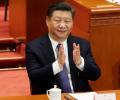
Xi, the most powerful leader in recent decades heading the ruling Communist Party and the military, will now be the first Chinese leader after the founder chairman Mao Zedong to remain in power lifelong.

The removal of the term limit will give Xi a limitless tenure.

'The men in black suits and hair dye in Beijing have not only completely blown the cover story of "peaceful rise," but have managed to antagonise regional powers in the Indo-Pacific.'

'That the two sides allowed such a situation to arise exposed the level of inaction and inefficiency in China-India border management.' 'The Modi-Xi meeting in Xiamen initiated a process to to avert such contingencies in the future.'
'The boundary dispute notwithstanding, China has always had leaders who have been, on the whole, positively disposed towards India.' 'Given the centrality of the Chinese Communist Party, we need to strengthen the linkages with the crucial personalities in the highest echelons of the Communist party and political leadership,' notes China expert Alka Acharya.

Important for India was Xi's meeting with representatives of PLA officers and soldiers stationed in Tibet. The video of the encounter was interesting to watch, especially the large number of lieutenant generals and major generals, observes Claude Arpi.

Policy of continuity won't help India earn business or respect, says Pramod Kumar Buravalli.

'Unlike the Chinese army that has been largely a peace time force, the Indian Army is a battle hardened force,' explains Colonel Anil A Athale (retd).
